
The short answer
Hawaii's landlord-tenant code, section 521-56, lets a landlord sell, store or donate belongings a tenant abandoned once the tenant has quit the unit. Before selling or donating anything of value, the landlord mails a notice and waits fifteen days. Items the landlord decides have no value "may be disposed of at the landlord's discretion without liability to the landlord." We're haulers, not lawyers, and this isn't legal advice.
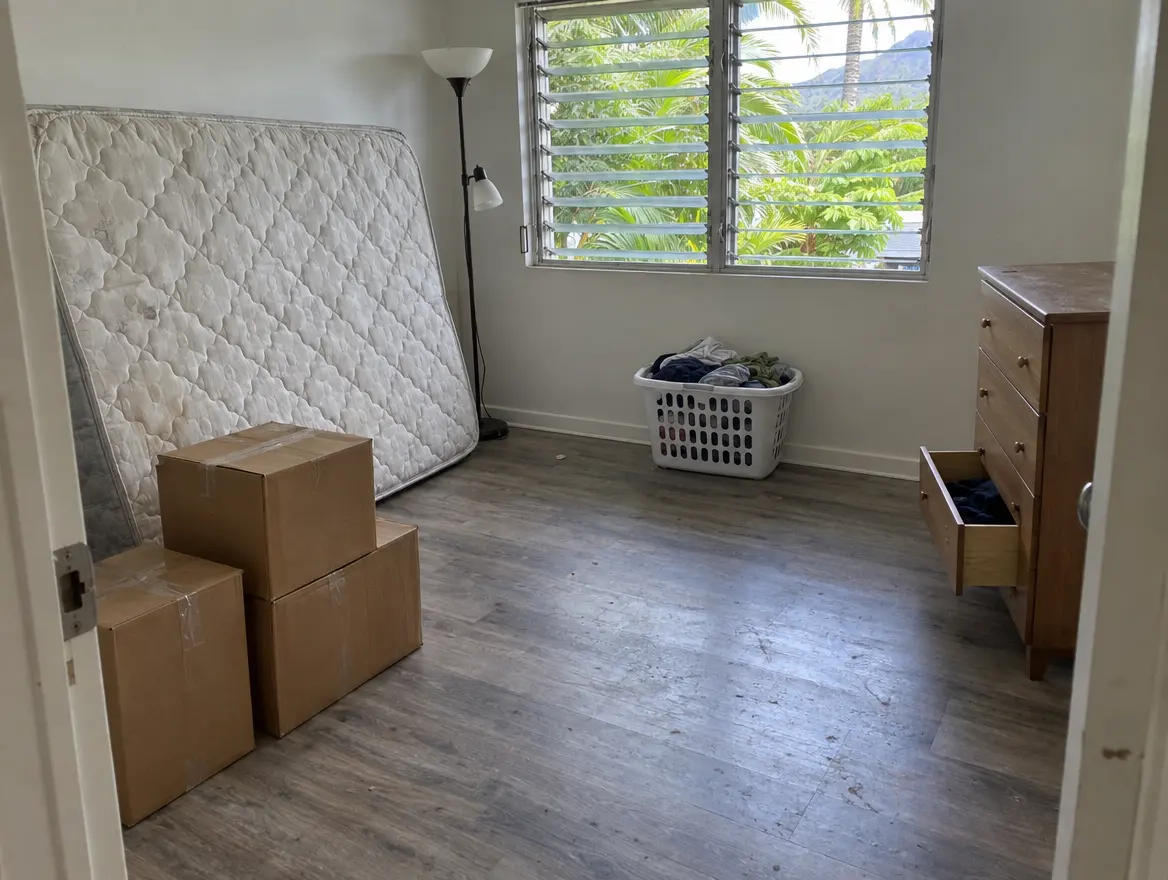
We're Hawaii Hauling, two brothers born and raised in Lahaina, hauling junk on Maui since 2024. We're haulers, not lawyers, and this isn't legal advice. Every rule below is quoted from the state's own pages, read on 10 November 2026, with the link beside it.
The two piles in section 521-56
| The pile | What the code says | When it can go |
|---|---|---|
| Has value | Sell it, store it "at the tenant's expense", or donate it to a charity | No sooner than fifteen days after the notice is mailed |
| No value | "May be disposed of at the landlord's discretion without liability to the landlord" | The code states no notice and no wait |
| A car | The code doesn't mention cars. The state's FAQ excepts "items which have title to them, such as a car" | Call the state line first |
Source for all three rows: section 521-56 and the Office of Consumer Protection's FAQ.
When has a tenant really left, under the code?
Section 521-56 only applies once the tenant has quit the unit, and it names three ways that happens. The tenant "has wrongfully quit the premises", or has quit "pursuant to a notice to quit", or has quit "upon the natural expiration of the term" (section 521-56). A unit that just looks empty isn't on that list.
| The test | The code's words |
|---|---|
| Words or deeds | The tenant "unequivocally indicates by words or deeds the tenant's intention not to resume the tenancy" (section 521-70) |
| Twenty days | The tenant "is absent from the dwelling unit for a continuous period of twenty days or more without written notice to the landlord" (section 521-44) |
| The catch | The tenant isn't absent "during any period for which the landlord has received payment of rent" (section 521-44) |
That last row matters more than it looks. A tenant who paid through the 30th and vanished on the 5th isn't twenty days gone on the 25th. The clock and the rent receipt have to agree, and the rent receipt always wins.
Guessing early is the expensive mistake. If a landlord "removes or excludes the tenant from the premises overnight without cause or without court order", the tenant can recover "an amount equal to two months rent or free occupancy for two months", plus the cost of the suit (section 521-63).
So before anything in that bedroom moves, I'd want the date the tenant left written down, and how you know it.
The two piles: what has value and what does not
The code makes the landlord sort what's left into two piles, and it has to be done honestly. The first pile is what the landlord, "in good faith, determines to be of value" (section 521-56). The second is what's left over and "determined by the landlord to be of no value". The state's own FAQ says it plainly: "The landlord must do this in good faith" (Office of Consumer Protection).
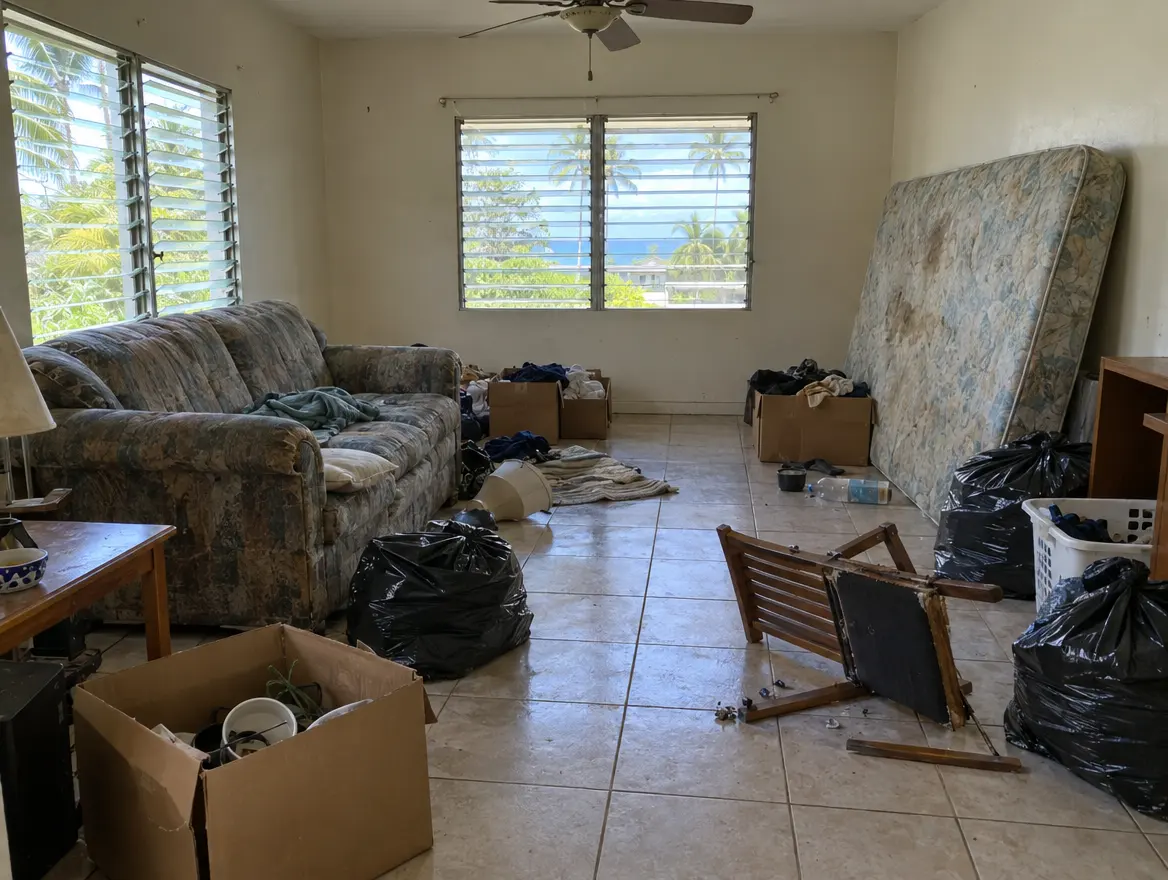
What the code doesn't give you is a dollar line, or a list. Nobody in Honolulu wrote down whether a three-legged futon counts. (The futon has opinions, but the code doesn't ask it.)
The code doesn't require photos or a written list either. Take them anyway. A phone video of every room, with the date on it, is the cheapest way to show later that the sorting was done in good faith.
The no-value pile is the one the code lets go without a wait. Once you've decided what's in it, hauling it is a normal rental cleanout. The value pile has a clock on it, and that's the next section.
The notice and the fifteen days
Before selling or donating anything of value, the landlord has to mail the tenant a notice and then wait fifteen days. The code's words: the sale or donation "shall not take place until fifteen days after notice is mailed, after which the tenant is deemed to have received notice" (section 521-56).
Write what and where. The notice tells the tenant "the identity and location of, and the landlord's intent to sell or donate" the belongings.
Mail it. The code says "by mailing notice". It doesn't mention a text, an email or a note taped to the door.
Use the address the code names. "The tenant's forwarding address" or "an address designated by the tenant", and only if neither exists, "the tenant's previous known address".
Wait fifteen days from the mailing date. Keep proof of the day it went in the mail.
| Day | What happens |
|---|---|
| Day 0 | The notice is mailed |
| After fifteen days | A sale or donation can't happen before this |
| Before a sale | At least three days in a row of newspaper advertising |
| After a sale | What's left of the money is held thirty days for the tenant |
No forwarding address? The state's FAQ says the last known address "would be the address of the rental unit" (Office of Consumer Protection). So yes, you may end up mailing a letter to your own empty rental. It feels like leaving yourself a voicemail, and it's still the step that starts the clock.
I couldn't find a state form for this notice, and the code doesn't say whether the fifteen days are calendar days or business days. If either one worries you, that's a question for the state's information line further down.
Sell, store or donate: what the code says about the money
For the value pile, the landlord "may sell such personalty, in a commercially reasonable manner, store such personalty at the tenant's expense, or donate such personalty to a charitable organization" (section 521-56). "Personalty" is the code's word for belongings. It's also the last time anyone will call a box of mismatched Tupperware something that fancy.
| The choice | The extra step | The money |
|---|---|---|
| Sell | Advertise "in a daily paper of general circulation within the circuit" for "at least three consecutive days" | Take out back rent and the costs of storage, advertising and the sale. Hold the rest thirty days. |
| Store | None stated, and no time limit stated | "At the tenant's expense" |
| Donate | None beyond the notice and the fifteen days | None |
On a sale, the proceeds are "held in trust for the tenant for thirty days, after which time the proceeds shall be forfeited to the landlord" (section 521-56). Whatever didn't sell can then be disposed of like the no-value pile.
Donating has fewer steps than selling. Our furniture donation guide has who picks up, who takes what, and what they turn down. What a charity turns down is still yours to sell, store or judge, in good faith, to have no value.
After an eviction: who removes what
After a court eviction, an officer removes the tenant, never the landlord. The state's FAQ is blunt about it: "A landlord may not remove a tenant by locking them out, changing the locks, or shutting off utilities" (Office of Consumer Protection). The case goes to District Court, and on Maui that's the Second Circuit in Wailuku (Maui court forms).
One date to know, because a lot of websites still have the old one. Since 5 February 2026, the written notice for unpaid rent is "not less than ten calendar days after receipt", up from five business days (section 521-68). The court's own sheet for Maui landlords adds that the notice also goes to Maui Mediation Services, and that the landlord "must participate in mediation if the tenant schedules mediation" (Hawaii State Judiciary).
If the landlord wins, the court issues a writ of possession. The Maui form commands the officer "TO REMOVE Defendant and all persons holding under or through him/her/them from the premises, including his/her/their personal belongings and properties" (Maui writ of possession form). The statute behind it is section 666-11.
What none of those pages say is where the belongings go after that, who pays to move them, or how long anything has to be kept. I couldn't find that answer in the code, on the writ form or in the state's handbook.
So before disposing of anything of value after a writ, ask the state line or an attorney. The state line is free.
When a tenant has died: section 521-85
A tenant's death has its own section, added in 2024, and the steps aren't the same as section 521-56. The landlord contacts the tenant's named representative "by registered mail", or sends the notice to the tenant's estate at the unit's address if nobody was named (section 521-85).
| Step | Section 521-85's words |
|---|---|
| Access | A representative who answers "within fifteen calendar days" gets access "to remove the deceased tenant's personal property in a reasonable manner" |
| The end date | The tenancy ends "fifteen calendar days from the date the notice is mailed or personally delivered", or the date rent is paid through, "whichever is later" |
| Has value | After that date: sell, store "at the expense of the deceased tenant's estate", or donate |
| No value | "Trash and perishable food" can go "immediately and without notice" |
The state's handbook walks through the same steps on its pages 17 to 19 (2024 Landlord-Tenant Handbook). When a family is clearing the whole home and not only a rental unit, that's the job our estate cleanouts page covers.
What the code does not say, and who to ask
The code leaves real gaps, and the safe move with each one is to ask before acting. These are the ones a Maui landlord runs into.
| Gap | What the sources say |
|---|---|
| A car | The code doesn't mention cars. The state's FAQ excepts "items which have title to them, such as a car" from the sell, store or donate choices and gives no steps. |
| The deposit | The deposit can be used to "clean the dwelling unit or have it cleaned", with written proof within fourteen days (section 521-44). The code doesn't say whether a hauling bill counts as cleaning. |
| A roommate | A roommate who stayed isn't covered. The section talks about "the tenant" only. |
| The newspaper | "A daily paper of general circulation within the circuit." The code doesn't name one. |
I can't answer the deposit row for you. What I can do is put the landfill's scale receipt on your invoice, so whoever does answer it has the paperwork.
| Who | For what | How |
|---|---|---|
| State line | The state's information line, for general questions on the code. It can't give legal advice. | 1-844-808-3222, weekdays 8am to noon (Office of Consumer Protection) |
| Mediation | Maui Mediation Services, for mediation between landlord and tenant | (808) 244-5744, by appointment (Maui Mediation Services) |
| The court | District Court in Wailuku, for forms and filing | (808) 244-2706, 2145 Main Street, Room 141 (Hawaii State Judiciary) |
The state line calls back the same day if you ring before noon. For anything with real money or a real dispute attached, an attorney is the right call, and none of us on the truck is one.
What we see when the keys come back
Our part starts once the legal part is done and the unit still isn't empty. A few things from our side of the door.

- You decide what goes. We haul it. We don't sort a tenant's belongings into value and no value, because the code gives that job to the landlord. Tell us which pile is ours and we'll leave the rest where it is.
- Two piles can mean two trips. We can take the no-value pile the day you call. Anything you're holding for the fifteen days stays put, and we come back for whatever is left after it.
- You don't have to be there. Send photos or walk us through once, and we'll work with whoever has the keys.
- The price comes before the lifting. A full cleanout where we load everything usually runs $1,500 to $2,500. A couple of items, like a couch and a mattress, usually run $300 to $500, confirmed on site before we load.
Loading takes three to four hours, plus about two for the landfill run, so a cleanout is done in a day. What junk removal costs on Maui has the rest of our prices. Free estimate from photos. Text them to (808) 359-8130.
Hawaii landlord-tenant code questions
Straight answers. Something missing? Call us.
What can a landlord do with belongings a tenant left behind in Hawaii?
Under section 521-56 of the Hawaii Revised Statutes, once the tenant has quit the unit, the landlord can store abandoned belongings that have value at the tenant's expense, or sell or donate them after mailing a notice and waiting fifteen days. Belongings the landlord decides in good faith have no value can be disposed of at the landlord's discretion.
How long does a landlord have to keep a tenant's belongings in Hawaii?
The code sets one waiting period: a sale or donation can't happen until fifteen days after the notice is mailed. It sets no storage period. A landlord who chooses to store the belongings does it at the tenant's expense.
When is a rental unit considered abandoned in Hawaii?
The code calls it wrongfully quitting. It applies when a tenant wrongfully quits and "unequivocally indicates by words or deeds" that they won't resume the tenancy, or is absent twenty days or more in a row without written notice. A period the tenant has already paid rent for doesn't count toward the twenty days.
Can a landlord throw away a tenant's things in Hawaii?
Only what the landlord determines has no value, and only after the tenant has quit the unit. Belongings with value need a mailed notice and a fifteen-day wait before they're sold or donated. A landlord can't lock a tenant out or shut off utilities to remove them.
How much notice is an eviction notice for unpaid rent in Hawaii?
Since 5 February 2026, the written notice for unpaid rent must give the tenant at least ten calendar days after receipt. Before that date it was five business days. A month-to-month tenancy takes forty-five days' written notice from the landlord.
Who can I call about the Hawaii landlord-tenant code?
The Office of Consumer Protection runs a free information line at 1-844-808-3222, Monday to Friday, 8am to noon. It gives general information about the code, not legal advice. For a specific dispute, talk to an attorney.
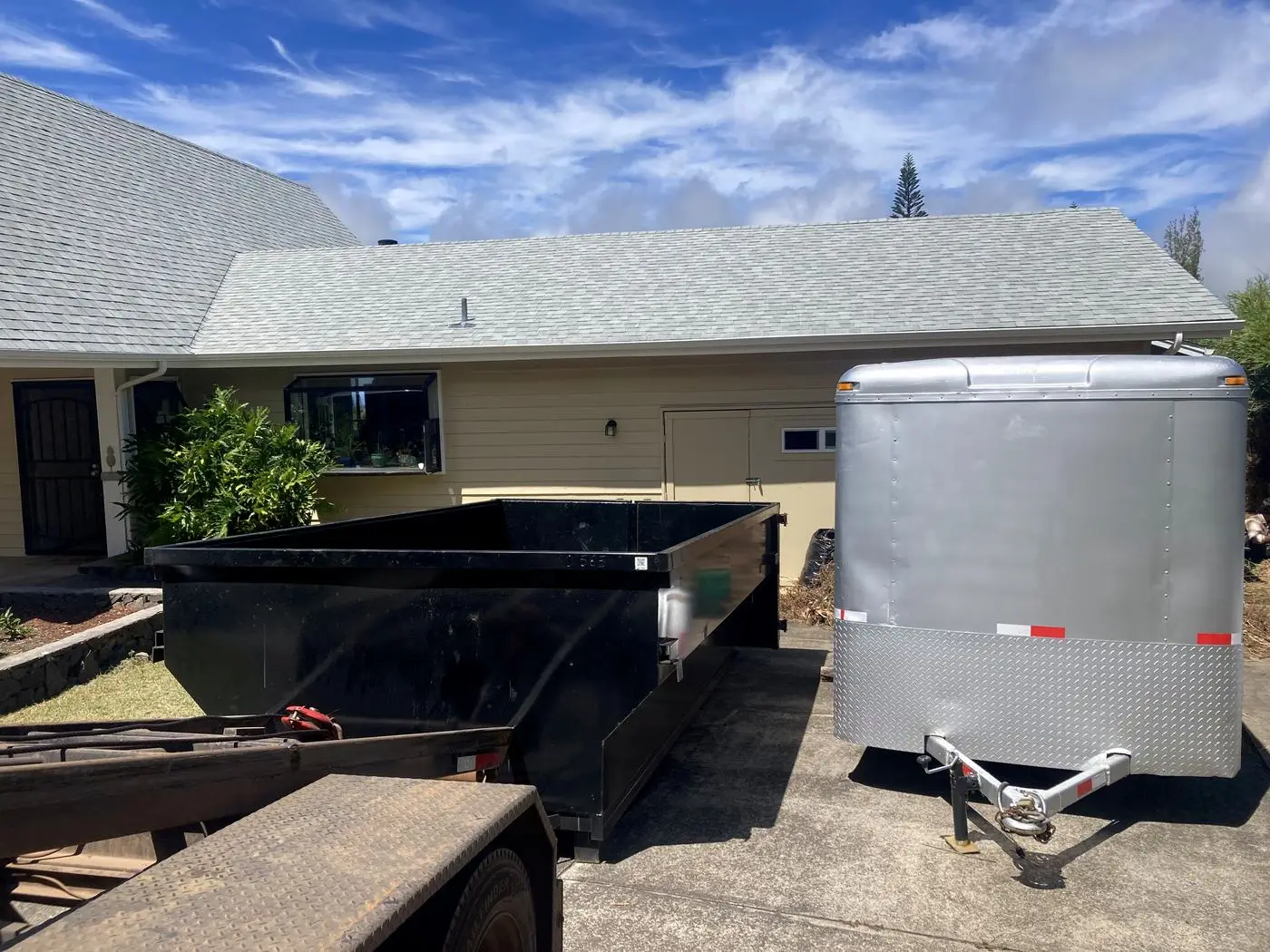
The notice is yours. The lifting can be ours.
Once you know which pile can go, text photos of the unit and we'll text you a price. We load it and make the landfill run, the same day when you need it, and the scale receipt comes with your invoice. A full cleanout usually runs $1,500 to $2,500. How our rental cleanouts work, or call (808) 359-8130.
Read this next: Where to donate furniture on Maui, and who picks it up